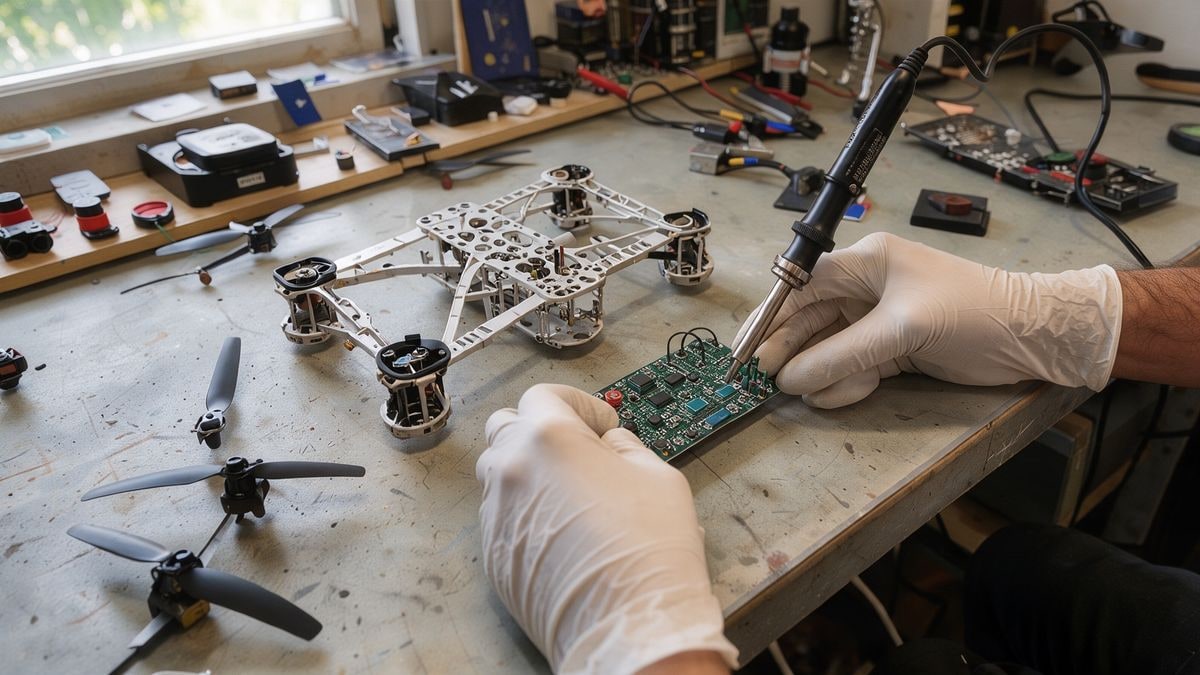


Carlos III University of Madrid coordinates PRIME-6G, a European project with nearly 6 million euros that will test 6G networks and artificial intelligence in factories. Initial tests will be conducted in Leganés.
The Carlos III University of Madrid (UC3M) coordinates the European project PRIME-6G, which develops a communication architecture based on 6G and artificial intelligence so that industrial plants can manufacture fully customised products. According to lavozmadrid.es, the consortium also includes the IMDEA Networks Institute.
The technology will first be validated in laboratories in Leganés and then in a real industrial environment in Germany. The goal is to manufacture unique items one by one without stopping or reconfiguring the machinery for each order, something that current wired and wireless networks do not allow with the reliability and timing precision required for critical tasks.
The project has two use cases. The first, AURORA, led by Siemens AG, will enable autonomous vehicles and collaborative robots to negotiate tasks among themselves in real time, without relying on a central computer. According to project data, two vehicles will be able to coordinate to transport heavy loads with a latency of less than 15 milliseconds.
The second case, SENTINEL, led by IMDEA Networks, will convert the communication signal into radar. By analysing how radio waves bounce in the environment, the network will detect people, robots, and obstacles, even in blind spots. With that information and existing sensors, a three-dimensional digital twin of the facility will be created, with an accuracy of about 20 centimetres for fixed objects and 30 centimetres for moving ones.
With PRIME-6G, we are creating an intelligent and time-precise network that allows flexible automation to move from the laboratory to real-world factories.
This is explained by Carlos Bernardos, project coordinator and researcher at UC3M and IMDEA Networks, who points out that current wireless networks do not guarantee that a control command arrives at the exact moment a robot needs it.
The team is fine-tuning this 6G radar at NEXTONIC, a research laboratory opened in Leganés, managed alongside IMDEA Networks and Telefónica. After tests in Leganés and at Siemens facilities in Garching (Munich), the technology will move to Stuttgart to be integrated into a joint pilot within ARENA2036, a research campus that operates as a real-scale factory.
The project, funded by the Smart Networks and Services Joint Undertaking under the Horizon Europe programme, will last two and a half years, from June 2026 to November 2028, and has a grant of nearly 6 million euros. In Spain, Telefónica Innovación Digital, the Telecommunications Technology Centre of Catalonia, Fivecomm, Robotnik Automation, and The Laude Technology Company are also participating.
Trending on the web




You may also like