The exhibition, inaugurated this Tuesday at the Palacio de Longoria, reviews the creative facets of the Riojan screenwriter and writer. It can be visited for free until October 30.
The General Society of Authors and Publishers (SGAE) commemorates the centenary of the birth of Rafael Azcona (Logroño, 1926 - Madrid, 2008) with an exhibition at the Palacio de Longoria, the entity's headquarters in Madrid. The exhibition, inaugurated this Tuesday, will be open until October 30, from 4 to 9 PM, with free entry, as reported by larioja.com.
Curated by screenwriter and playwright Bernardo Sánchez Salas, the exhibition is conceived as a memory album that explores the "numerous and prolific creative and vital facets" of the author, according to SGAE. Sánchez delves into Azcona's figure: "Internationally famous for his film scripts, created throughout his life for some of the best directors in Spanish and Italian cinema, and considered in our country, and for several different generations, as a master of screenwriting and an essential professional and personal reference, Azcona, during the time between his youth in the province and the Madrid bohemia of the 50s, also developed other activities, such as narrative, poetry, drawing, humour, or press collaborations. All of these are present in this exhibition."
The exhibition includes an audiovisual piece titled 'Rafael Azcona, two or three things we know about him', created by David Trueba. The filmmaker has sought to explore the life philosophy of the honoured creator through a journey through some sequences of films in which he collaborated on the writing. "There, certain recurring elements of his way of thinking, of his view of the world, can be intuited," reveals Trueba. He adds: "Rafael Azcona has been a powerful storyteller who has left an immense mark in telling us about ourselves as a society." The montage will be continuously exhibited in a specific area of the exhibition set up as a period projection room.
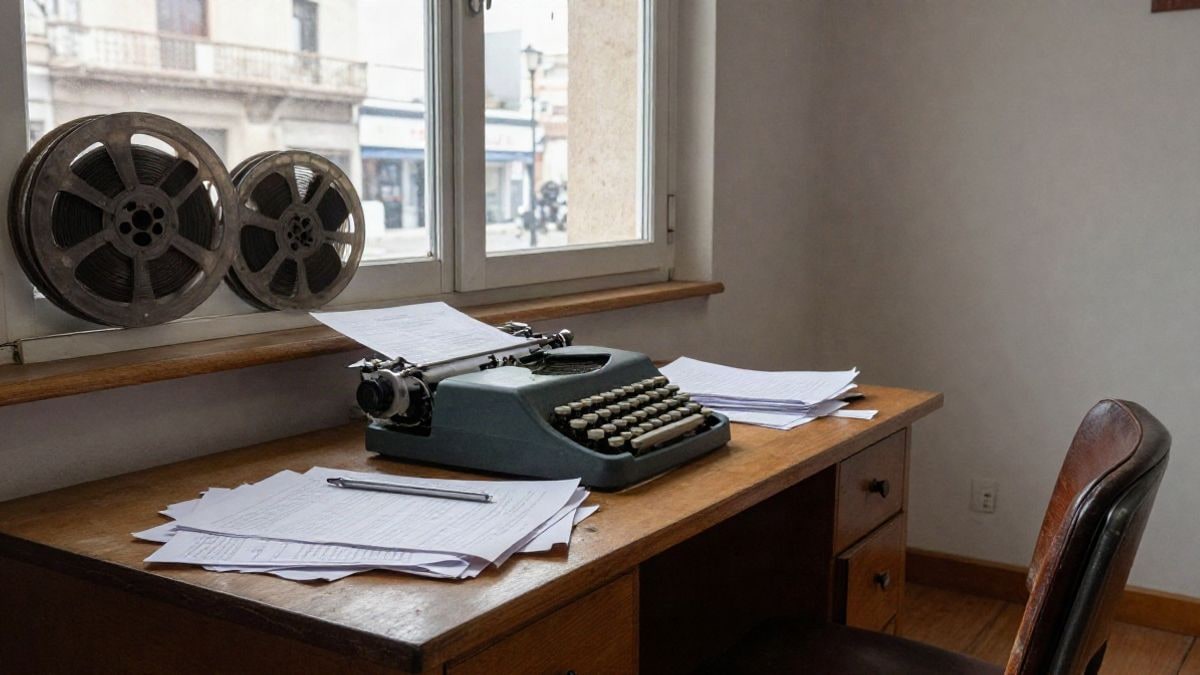
The exhibition brings together original documents, copies of his novels, historical publications, graphic material, and personal objects, loaned by the Mingote Foundation, the Rafael Azcona Library in Logroño, the Institute of Riojan Studies, the History Museum of Madrid, the publishing house Pepitas de Calabaza, and various private collections. Among the pieces are sheets with poems typewritten by Azcona himself in the early 50s, before leaving his native Logroño, and first editions of the novels he published both under a pseudonym and under his own name.
A selection of his articles and cartoons published between 1954 and 1956 in the newspaper Pueblo, and copies of the satirical magazine La Codorniz, where he introduced his repugnant child Vicente, are also exhibited. The journey allows visitors to "delve into his various creative facets, discover the skill with which he navigated both words and drawing, and approach his particular way of understanding the world and his own artistic profession."
On the tour, one can see everything from a wax painting made by Azcona to a charcoal portrait of the screenwriter drawn by Javier Clavo and dated 1963, the year in which 'El verdugo' premiered. Also on display is a reproduction of the 'Portrait of the Poets' in which, in 1957, the Madrid artist Pedro Gross immortalised 79 bards who regularly attended the 'Versos a medianoche' recitals at the Café Varela. Rafael Azcona was one of them. In his book 'Los ilusos', published in 1958, he portrayed the bohemian and mischievous atmosphere of the Madrid poetic gatherings and evenings of those dark times.
The exhibition also includes other unique works, such as two Christmas cards designed by the Logroño author on his computer while becoming familiar with the graphic programs of the time, which he later sent to his friends. The statuette by artist José Carlos Balanza that the Arnedo Short Film Festival has awarded since 2006 as the trophy for the Rafael Azcona Award is also displayed; the original score by Rafael Azcona, composed by Carmelo Bernaola for the soundtrack of the film Pasodoble, by José Luis García Sánchez; photostats of some of his feature films and other documents.
The exhibition also includes the scripts of four projects Azcona worked on during the last two decades of his life, but which never materialised: '¡Viva Rusia!', his last collaboration with Luis García Berlanga, which was to close the film saga starring the Leguineche family; 'Las hermanas del Don', co-written with José Luis Borau; some of the scripts for the television series Crónicas urbanas, based on stories by Manuel Vicent about life in the big city; and 'El laberinto', an adaptation for the screen of the novel 'Autobiografía', by Medardo Fraile.
The vice president of the Audiovisual College of SGAE, Inés París, explains the purpose of the tribute: "With this exhibition, SGAE, its authors and authors, wanted to remember and celebrate the creative universe of Rafael Azcona. What we call his many 'lives', since, in addition to writing an astonishing number of the most important films in Spanish cinema of the 20th century, he also demonstrated his inexhaustible talent in the fields of novel writing, poetry, journalism, or illustration. He is undoubtedly the 'father' of Spanish screenwriters and a true reference of our cinematography."
As part of this tribute, SGAE has also collaborated, along with Mercury Films, in the restoration of 'El verdugo', a 1963 film written by Azcona together with its director, Luis García Berlanga. The programming is completed with a cycle dedicated to the author, in which the film will be screened, along with two round tables.
You may also like